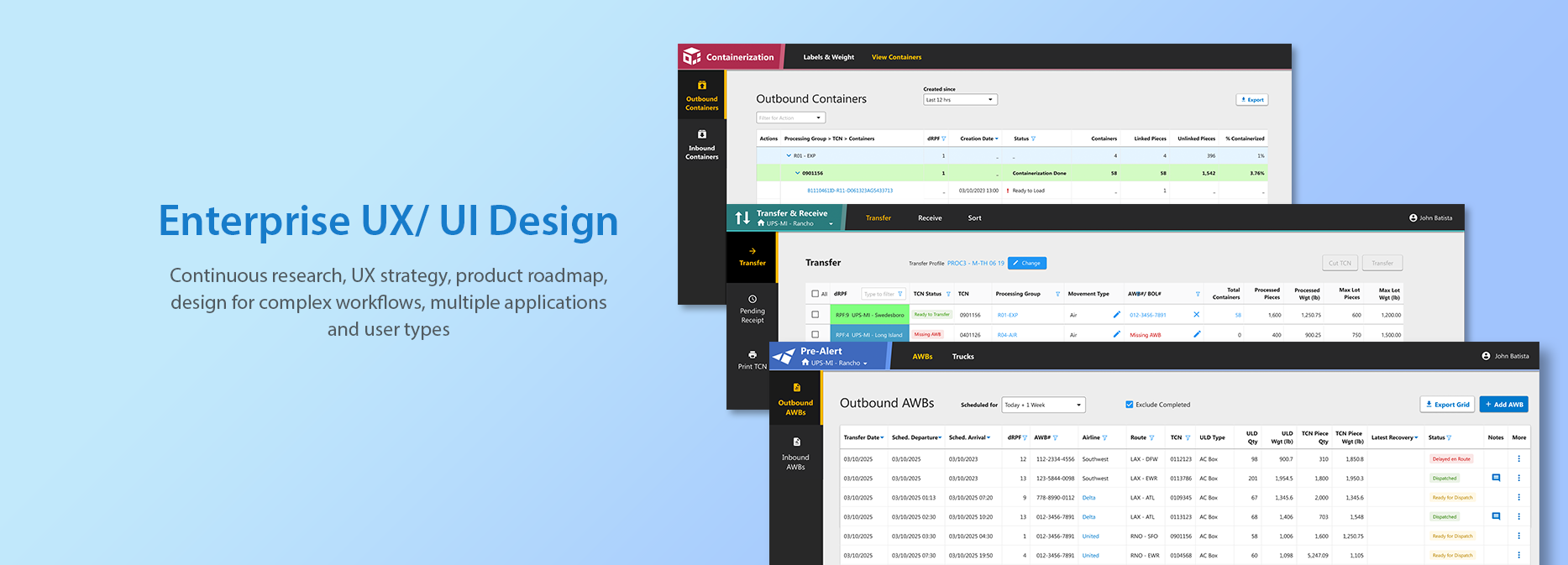
PROJECT OBJECTIVES
UPS's Mail Innovations (MI) Department started a significant modernization initiative in 2019. Business processes, technologies, and applications were revamped to ensure more efficient, faster, and accurate processing and delivery of mail.
Business Goals
Reduce manual and error-prone processes
Limit access to disconnected information
Ensure more visibility into data, planning and operations
MY ROLE & DESIGN OBJECTIVES
CONTEXT
The Mail Innovations (MI) Department at UPS works with postal services in the US and abroad to help businesses manage their end-to-end mailing needs, such as mail prepping, mail processing and transportation. The MI network consists of 22 facilities in the US.
“The areas of frustration and pain points in many cases are assigned to the lack of connectivity of information. Since inception we always [had] separate entry points.”
I led the end-to-end UX/ UI design efforts of three development teams through discovery, strategy, solution and implementation.
Design Objectives
Design 5 interconnected applications to support the business objectives of the modernized operational processes
Enable users of the suite to perform efficiently, have better visibility, reduce errors and problem-solve faster
Design optimized, seamless and cohesive user experiences across the suite
Ensure visual and behavioral consistency
Timeframe
2020 - 2024
Client
Mail Innovations, UPS
Role
Sr. UX/ UI Designer
MY ROLE

Led end-to-end strategy and design for a suite of 5 interconnected applications
Partnered with stakeholders and users to understand the business processes, goals, and user' needs for each application and the suite.
Led continuous research and translated complex concepts and large-scale processes into concrete process flows, user journeys, cross-product data flows, business and user outcomes, low and high-fidelity prototypes.
Successfully balanced tactical work and strategic thinking to avoid short-sightedness, rework and ensure teams had a long-term vision for the entire suite.

Orchestrated system-wide strategy & discovery
Spearheaded a systems thinking approach. Helped break the silos of knowledge, pushed for more holistic and strategic problem-solving.
Had a direct influence on the suite roadmap by introducing the concept of value delivery and mentoring the product triad to pivot from a feature-delivery model to an outcome-driven roadmap.
Drove team alignment & high-value delivery
Socialized research and insights. Kept decision-making grounded in research and alignment.
Led the development of a strategic suite roadmap allowing the business to see returns on long-term initiatives sooner.
Helped maximize value delivery and teams velocity by visualizing dependencies and pinpointing logical and executional efficiencies.


Maximized consistency, reduced rework
Scaled visual and behavioral consistency across the suite by iterating on shared user flows and design patterns.
Collaborated with engineering on a UI Implementation Wiki to codify design standards and frameworks, significantly reducing development and QA work.
Skills
Continuous UX research
Stakeholder collaboration
UX Strategy & roadmap
Strategic thinking
Cross-functional team collaboration
Passion for solving user and business problems
UX/ UI design
Visual communication
Presentation and feedback gathering
THE SUITE
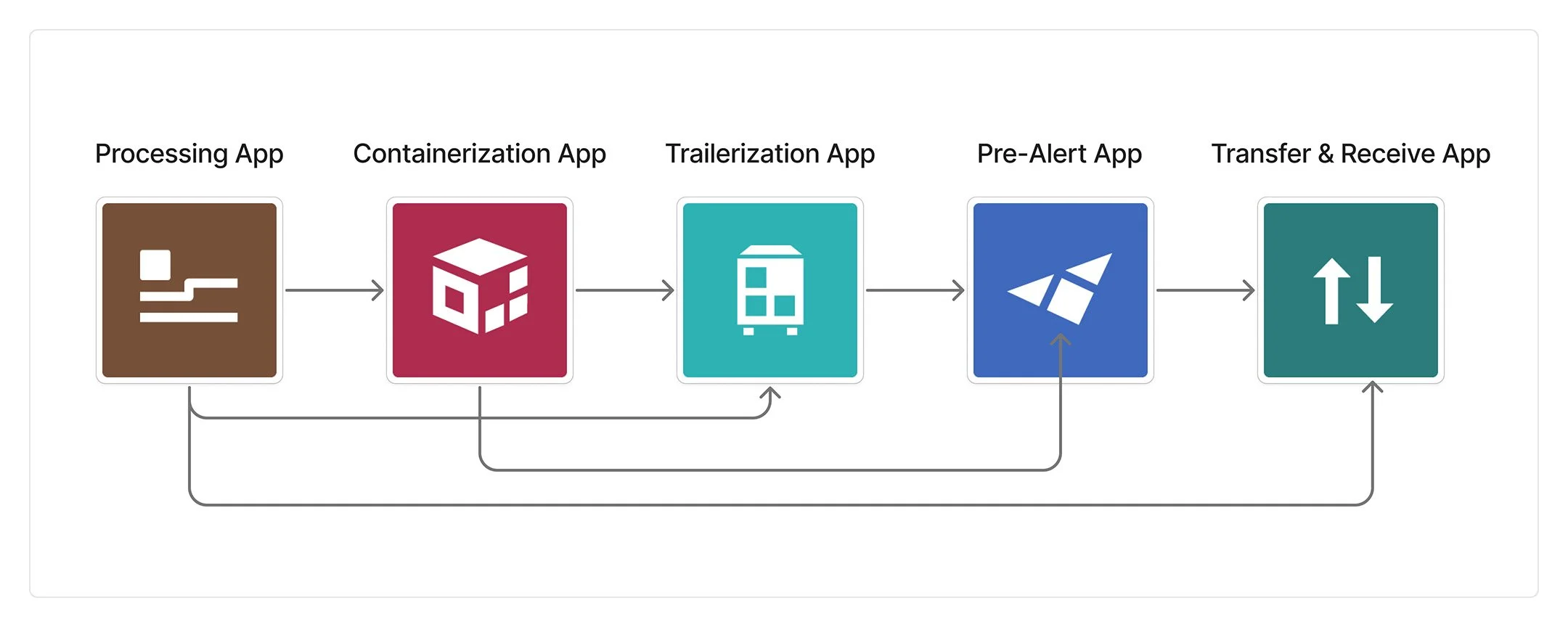
MI Ship Suite comprised of five applications for processing, transportation, monitoring and managing the transferring of mail in the UPS network.


MI PROCESSING APP
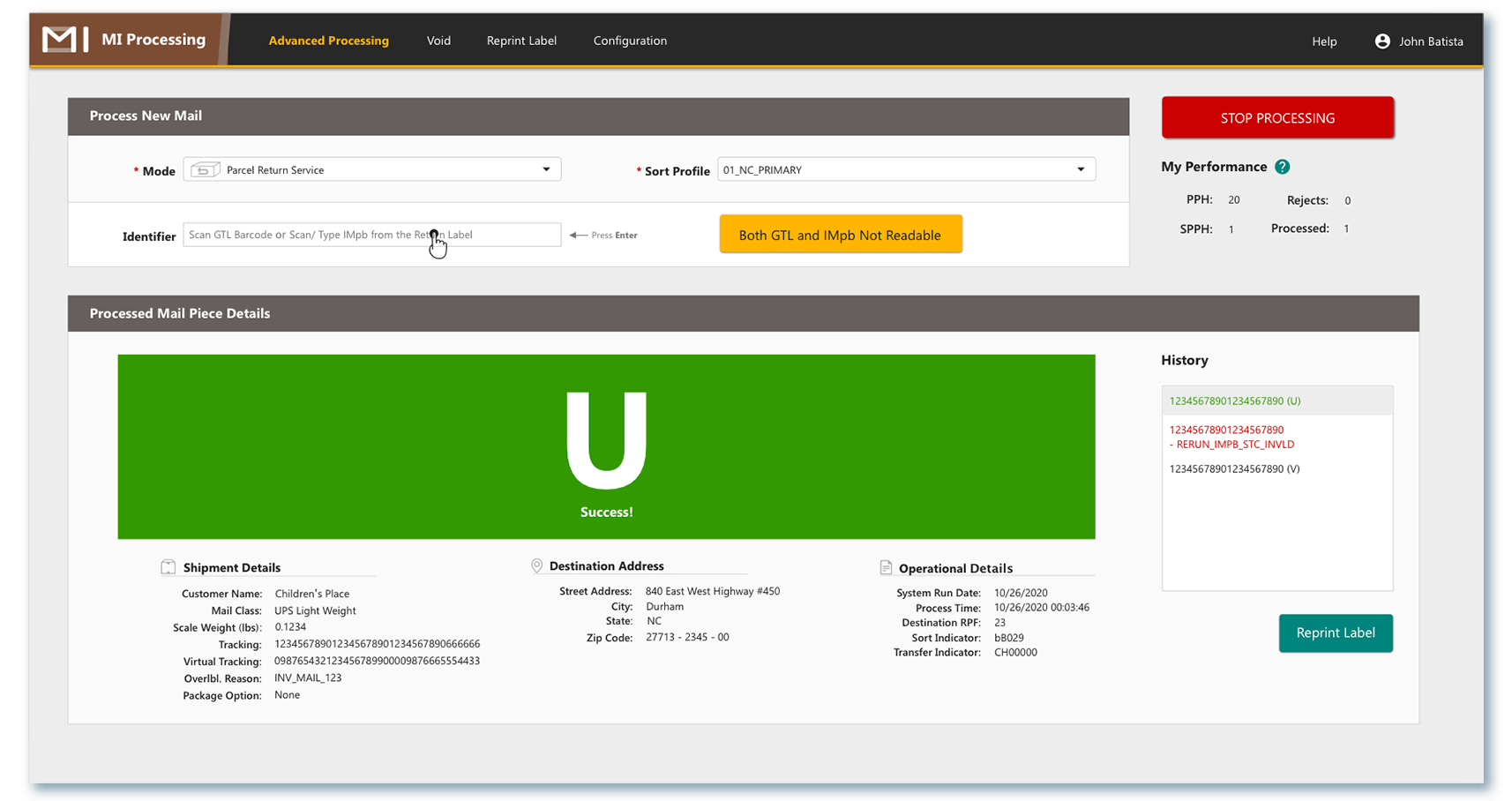

App for processing mail at an origin facility. Mail is scanned, weighed and redirected to a specific location in the processing facility based on the destination address. MI label is printed and is used for mail routing.
Business Value:
Increase mail processing speed and efficiency
Reduce processing errors
User Value:
Cleaner and more straightforward UI
Minimal screen interaction needed
Increased productivity
CONTAINERIZATION APP
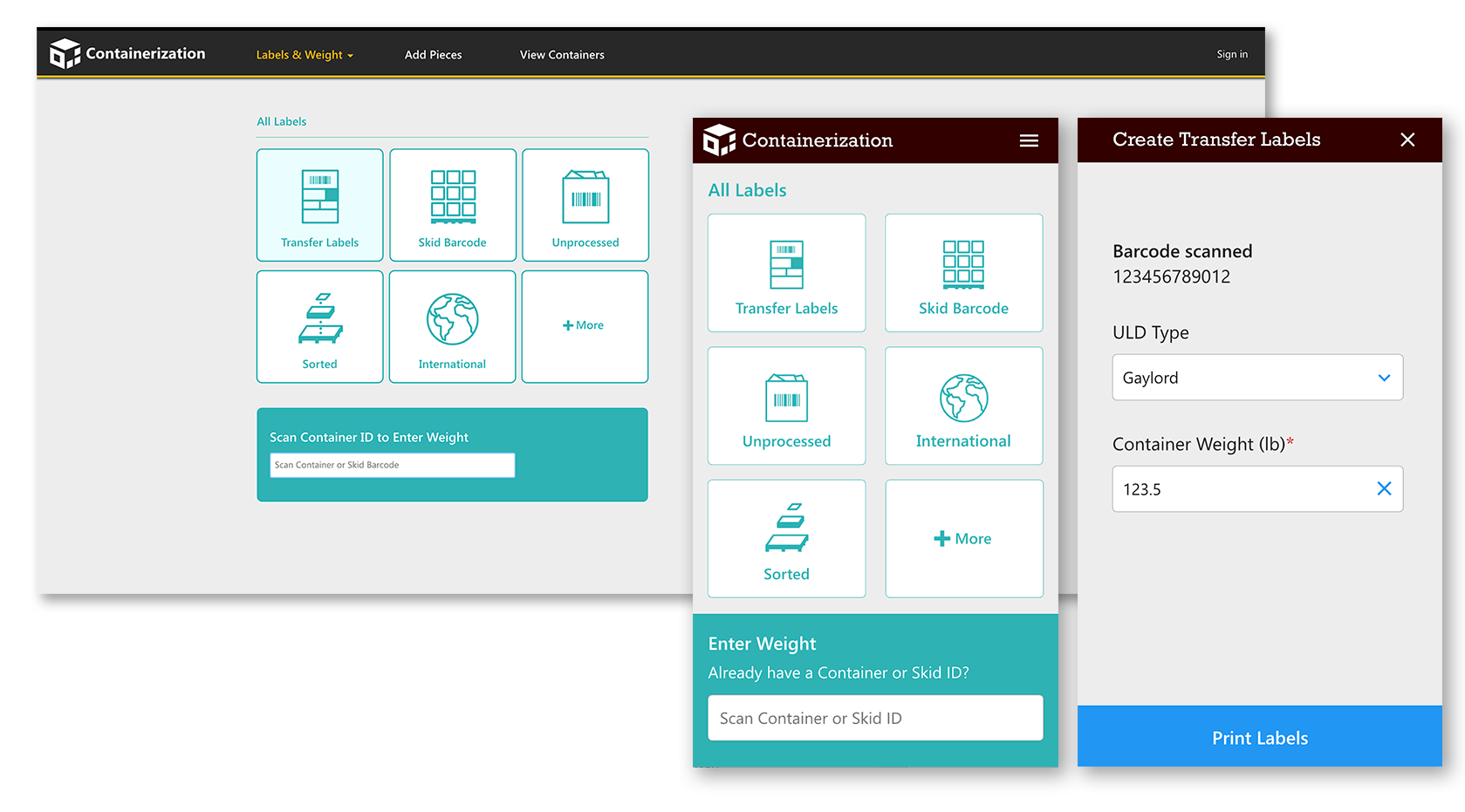
Responsive web app for desktop and mobile for creating container IDs, container labels and record container type and weight in the system.
Business Value:
Unique Container IDs created with container information saved for accounting and investigative purposes
User Value:
Clean and straightforward UI
Responsive design
Minimal screen interaction needed

TRAILERIZATION APP
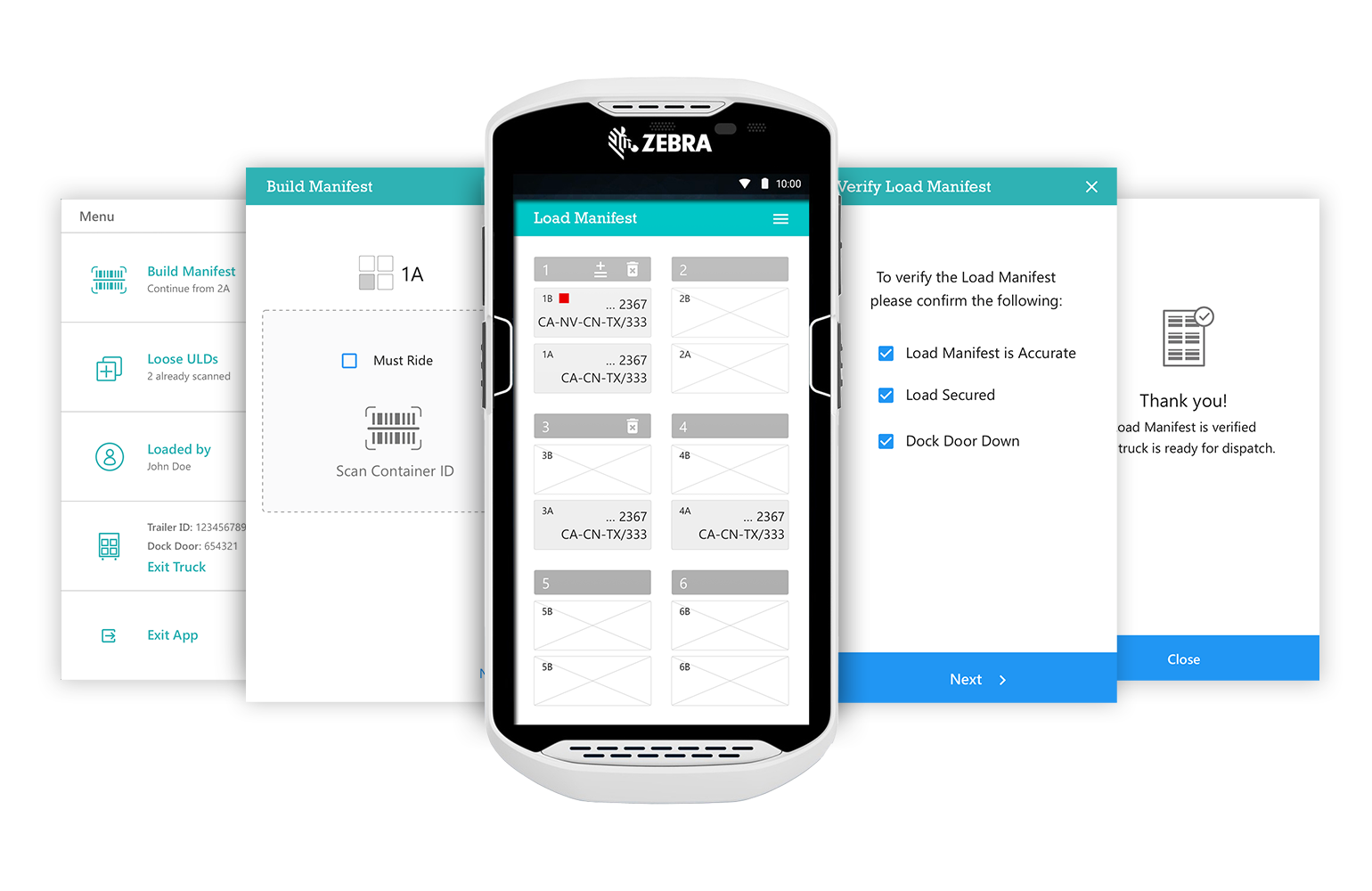
Mobile app for automating Load Manifest creation. Forklift drivers create online Load Manifests by scanning Container IDs. Load Manifests are easily shared between apps and accessible by origin and destination facilities.
Business Value:
Minimize redundant work, inefficiencies and human errors
Increase accuracy and share more granular information
User Value:
Eliminate manual work
Eliminate errors
PRE - ALERT APP


Desktop app for Transportation Managers and Operations Supervisors to monitor the progress and status of shipments, and communicate information between origin and destination facilities.
Business Value:
An online hub for shipments information
Increased visibility and accuracy of information
Improved communication between facilities
User Value:
Filters and color coded statuses facilitate prioritization and guide users
Easy access to other apps and supporting information
Improved ability to track mail in the system and problem-solve
TRANSFER & RECIEVE APP

A desktop app for monitoring the processing of mail and electronically acknowledging when mail is ready to leave the origin facility and received and sorted at the destination facility.
Business Value:
Increased visibility and accuracy of information
Improved communication between facilities
User Value:
UI facilitates prioritization and guides toward timely action
CASE STUDY
System-wide Discovery, Product Strategy and Roadmap
Context
The Mail Innovations (MI) Department was leading a large-scale initiative for modernizing processes, technologies and applications for processing and transportation of mail in the UPS network. The business recognized the importance of user experience in successfully delivering on the business objectives, but had limited understanding of the UX design process.
Challenges
The department was in its early stages of design maturity. Understanding of UX design was limited to screen design.
Multiple teams were working on multiple projects.
Teams were using SAFe methodology, but research was done ad hoc and piecemeal.
There was a vast knowledge gap between the business stakeholders and the development teams tasked with the implementation.
My Role
SYSTEMS THINKING & DISCOVERY
Partnered with business stakeholders and users to understand and connect the limitations and pain points of the legacy processes and applications to the vision for the future.
Spearheaded a systems thinking approach by leading continuous research. Helped break the silos of knowledge, pushed for more holistic and strategic problem-solving.
Socialized research findings and artifacts with project management and the engineering teams. Emphasized the “Whys” behind behaviors and requirements. Kept decision-making grounded in research and alignment.
From working on one application at a time to thinking about the entire system

Research of Legacy Processes, Pain Points & Opportunities
Multiple discovery sessions led to a document capturing the legacy lifecycle of a mail piece in the UPS network, the role of the legacy applications, user and business pain points, and strategic opportunities for improvement. It gave us a foundation for understanding and alignment. (Click image to enlarge)
User Needs Across the Suite
Three of the five applications in the suite were to be used by the same three user types. The personas included a section that talked about the user overarching needs and a vision of how each application was going to address these needs (click an image to enlarge).


Scaling Existing Design System
Because of the specifics of the flows and applications, I had to expand on the UPS Design System and scale custom components for the grids and modals. I continuously refined the components to achieve visual consistency while retaining simplicity and ease of use.
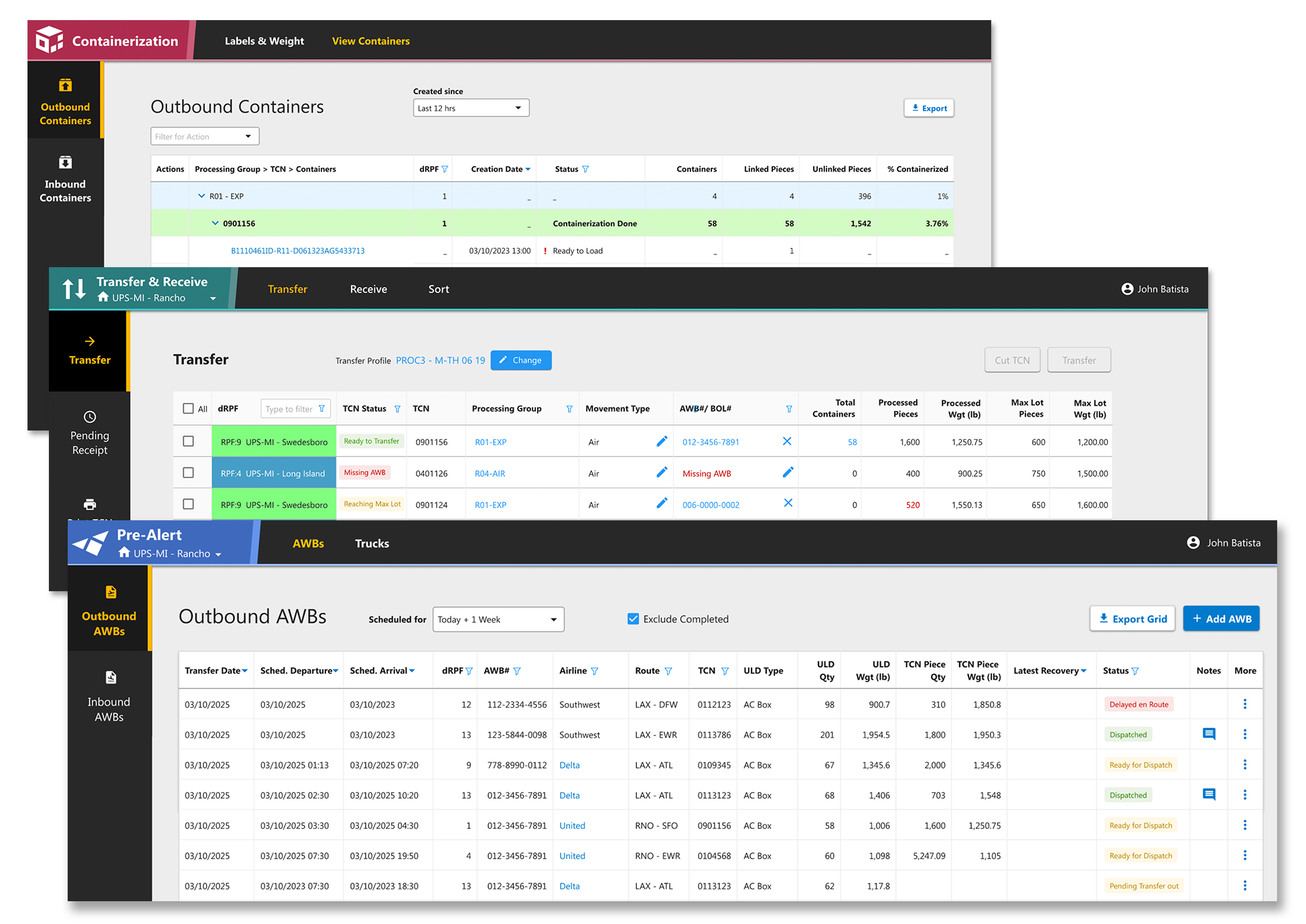
Standardizing the wording and color coding of the mail statuses in the suite.
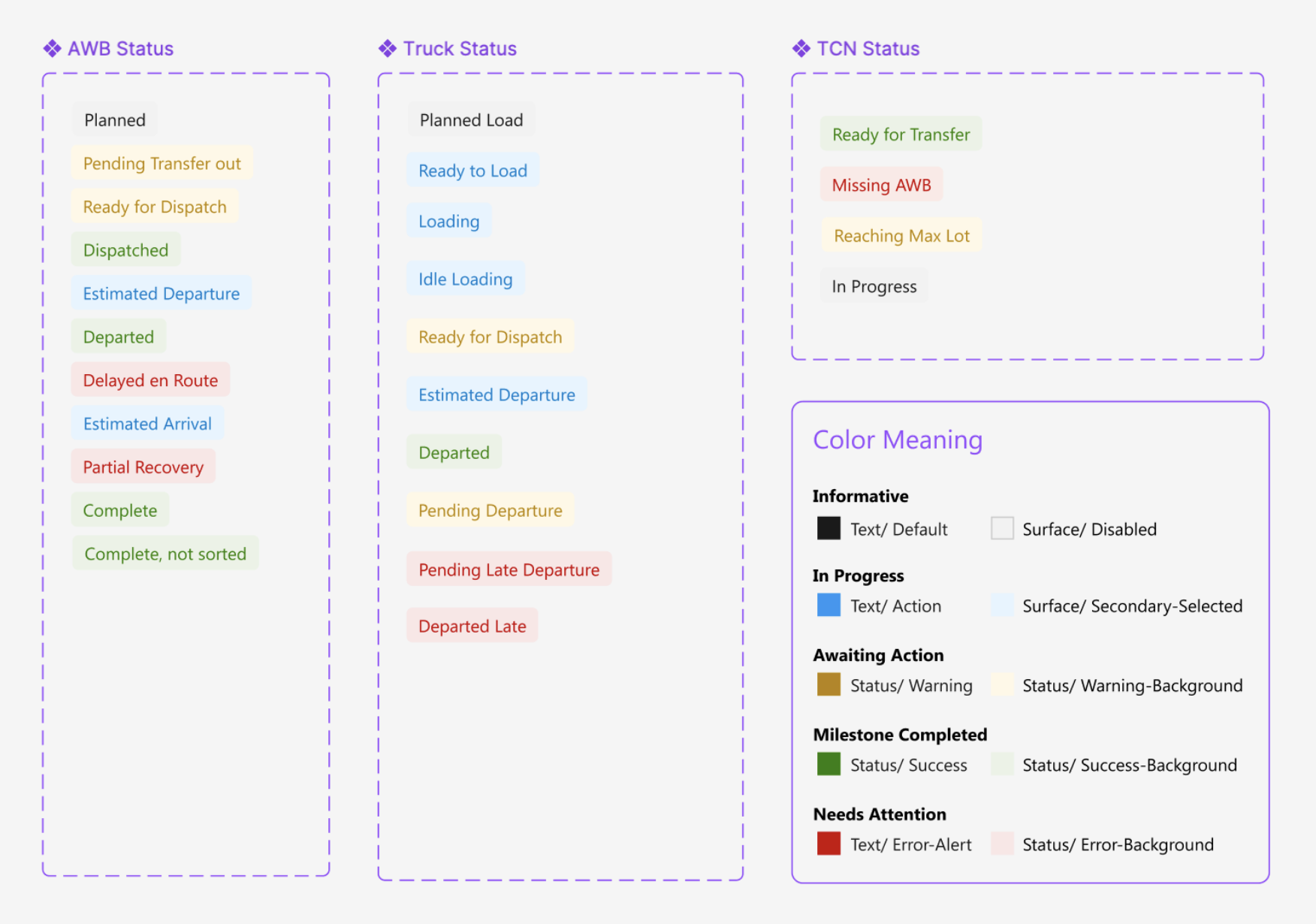
Created and Standardized Meaningful Mail Statuses Across the Suite
One of the main goals of the modernization was to increase users had more visibility into mail progress in the UPS network. I worked with the business stakeholders to:
Come up with meaningful and consistent mail statuses for each application
Record and document a holistic flow and status triggers and dependencies
Standardize the status naming and color coding across the suite
Below is a visualization of the air mail flow and mail statuses to be used throughout the suite. The visualization helped clarify the status triggers, dependencies, wording and color coding (click image to enlarge).

Pivot from feature to outcome-driven conversations
My work added new layers to our conversations - I introduced the concept to user and business outcomes and connected what we were asked to do to those outcomes and the overarching business goals (click to enlarge).

PRODUCT STRATEGY & TEAM ALIGNMENT
Translated complex concepts and large-scale processes into concrete process flows, user journeys, cross-product data flows, desired outcomes, low and high-fidelity prototypes.
Translated research and insights into desired business and user outcomes and mentored the product triad to pivot from feature delivery model to an outcome-driven roadmap.
Had a direct influence on the suite roadmap by visualizing dependencies and pinpointing logical and executional efficiencies.
Worked with the business stakeholders to define core MVP and post-MVP functionality and create a roadmap to deliver value incrementally.
Created a dual-track plan for the UX work and development work to ensure the team’s efforts were spent efficiently, strategically, and in synch to provide value to the business and users as quickly as possible.
Ensuring Connectivity of Information
My visualizations served as a North Star for the team. Below is a visualization about how the MI applications would work together to improve information connectivity and increase user visibility into mail in the UPS network. The diagram helped with planning, prioritization, and decision-making. (Click image to enlarge)


Ensuring connectivity and consistency of processes for air and ground mail
The operational processes varied for mail transported by air and ground. We had parallel and simultaneous discussions about air and ground mail and I created artifacts that took into account both modes of transportation to ensure connectivity and consistency (click image to enlarge).
SCALING VISUAL & BEHAVIORAL CONSISTENCY
Standardized component usage across the suite.
Collaborated with engineering on a UI Implementation Wiki to codify design standards and frameworks, significantly reducing development and QA work.
User Journeys Across the Future MI Suite
Parallel to my work on user journeys for each application, I worked on user journeys across the entire suite. We iterated on these journeys as we learned more about the business processes and refined the data flows. As a result, teams had context, clearer requirements and direction (click to enlarge).


Creating an MVP Version to Expedite Value Delivery
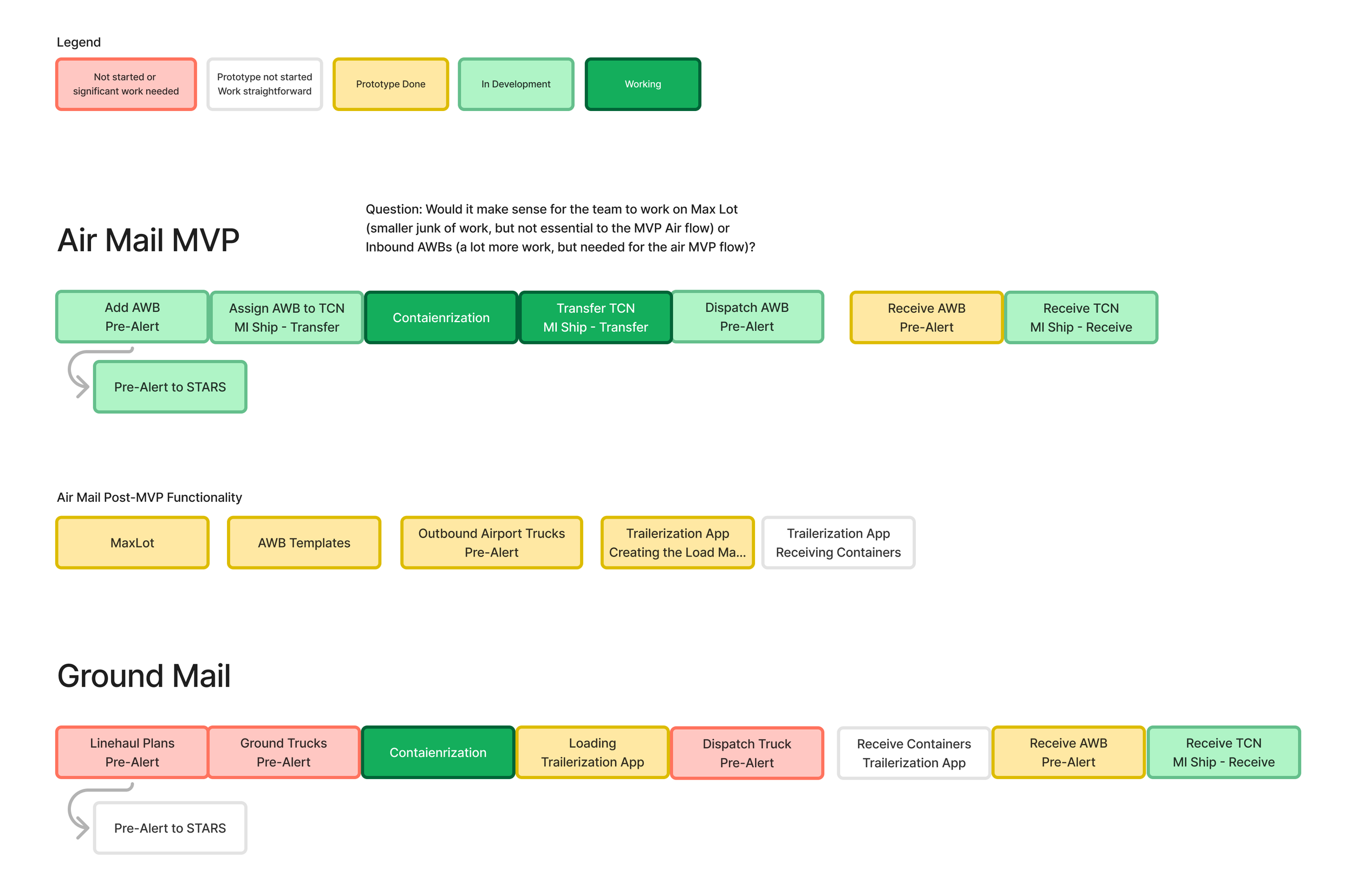
I led the envisioning of a scaled-down MVP version of the data flows for air and ground mail, which guided the PI planning, and facilitated decision-making and team alignment (click to enlarge).
Visualizing process dependencies and progress to inform decision-making
My visualization of the status of work demonstrated the value of prioritizing work on the air flow before the ground flow. It also informed the definition MVP and post-MVP functionality.
Dual-Track Roadmap for Delivering Value
I led the creation of a dual-track roadmap for the UX and development work to ensure the team’s efforts were spent strategically, efficiently and in synch to deliver value to the business and users as soon as possible. (click image to enlarge).

OUTCOMES
By championing a discovery-first approach, I transformed fragmented efforts into a cohesive product roadmap. This strategic alignment synchronized cross-functional teams and optimized our workflow to deliver measurable business results more efficiently.

User Satisfaction
Ease of use
Efficiency
Ability to plan
Reduced error rate

Team Success
Work with a vision and focus
Understanding dependencies
Allow for testing and improving
Confidence in project's progress

Business Success
Seeing results sooner
Increased efficiency
Reduced confusion and (re)work
Reduced operational and development costs
Improved customer service