Defined interim milestones and owned large sized projects
PROJECT SUMMARY
As a Sr. UX/ UI Designer, I influenced the roadmap of a system of 5 applications and streamlined the work of 3 development teams, reducing inefficient work, de-risking delivery and shortening time to completion.
MY ROLE
Because I was working with senior leadership on defining the vision for the system, and 3 development teams on developing the functionality needed, I was in a unique position to lead the team on developing a roadmap that ensured effective completion of the organizational goals.
I led program management through a process of defining the data flows needed to ensure connectivity of data and visibility to mail information in the system.
I drew attention to the differences in the flows for ground and air mail.
I flagged the risks of the teams working on disparate parts from both flows.
I visualized the status of work that had been done. I convinced product leadership to pivot to completing work on the air flow first.
I developed a dual track plan for the UX and development work for the air flow and streamlined further the development efforts of the team.
Timeframe
2021 - 2024
Client
UPS, Mail Innovations
Role
Sr. UX/ UI Designer, performing as a UX Researcher and a Sr. Product Designer
Collaborating with
3 development teams, 3 Product Owners, 3 Scrum Masters and MI senior management
Work Mode
Remote
CASE STUDY
Context
Between 2021 and 2024 I was working as an Experience Strategist for UPS, Mail Innovations. The department was responsible for managing the processing and transportation of mail in the UPS Network for corporate clients like Amazon, Macy’s, Barnes & Noble.
I was tasked with the UX/ UI design of an internal system of 5 interconnected applications, which while enabling the processing and transportation of mail in the UPS network, had to also support the organizational goal of increasing the accuracy and speed of delivering mail.
Because of the complexity and scope of the work, 3 development teams were working concurrently on the new infrastructure, back-end, and app development. The MI department was following SAFe methodology of development - we had PI and sprint planning ceremonies.
Even though efforts were made to streamline the work across multiple teams, the product development process was fragmented:
The vision was abstract and owned by senior management. Prioritization was done ad hoc and priorities often changed
Decision-making occurred in silos
Development teams worked piecemeal without a shared vision
Return on long-term initiatives was difficult to see and track
The Problem
Parallel to working on application specific research and design, I had been researching the role of each application in the system, the cross-platform user needs and workflows.
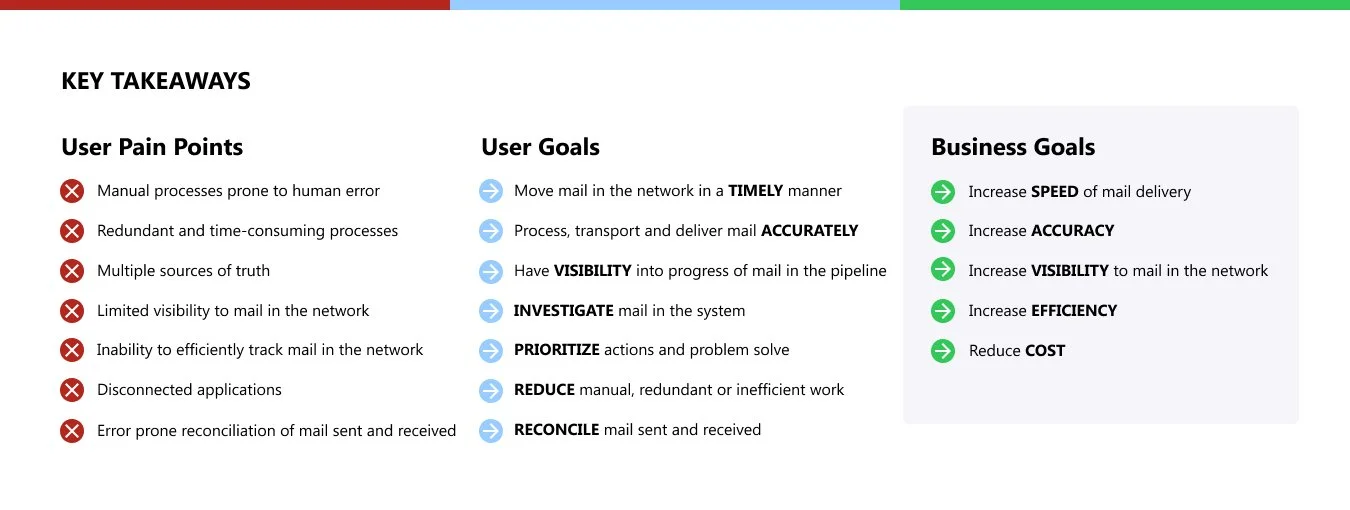
My research revealed that the biggest cross-system pain point was the lack of connectivity of data and lack of visibility to progress of mail in the system. To ensure the right data was communicated between the applications in the system, I had been working with a Senior Program Manager on defining the data and operation workflows for mail transported by ground and air. It became clear that the data and operational workflows for ground and air were substantially different, but the development teams had been working on disparate parts of the two flows. As a result we had multiple separate parts of the flows in various stages of development. Some parts were in development, for some we had prototypes in Figma, some - were still being researched. This approach posed several significant risks:
We were concurrently working on two separate complex workflows. It would take years to complete at least one of the workflows and be tested in its entirety.
Working piecemeal and expecting all pieces to one day align seamlessly was not realistic.
Not having clear focus and alignment was going to be expensive (in terms of inefficient, redundant or unnecessary work).
The Design Challenge
Design a system where diverse types of users successfully completed their cross-functional daily jobs to ensure mail got moved in the UPS network quickly and accurately. Ensure design decisions were made holistically and strategically.
I took ownership of the challenge and broke it down into the following steps:
Understand and connect the end-to-end business processes to the modernization goals of increasing the speed, efficiency and accuracy of transporting mail in the UPS network.
Understand the users of the system, their cross-system jobs in addition to their application-specific jobs.
Design solutions that enabled the completion of users’ jobs in support of the business goals.
Challenges
No direction was given. The goal was broadly defined as “we need to modernize the applications. We need to increase the speed, accuracy and efficiency of mail delivery”.
3 development teams to work with.
No other UX research and design resources. Before I joined the MI dev teams the decision-making had been heavily focused on the technical aspects of the projects. UX decisions had been made ad hoc, on intuition, with limited knowledge of actual users.
Highly complex business processes. Knowledge was fragmented and siloed.
2 separate workflows and user journeys for air and ground transportation modes.
Diverse operational roles with a variety of jobs for each application and the suite.
Role and Responsibilities
I acted as a core product partner to senior management in defining the business goals, user needs, product vision and solutions, and led the UX efforts for 3 development teams
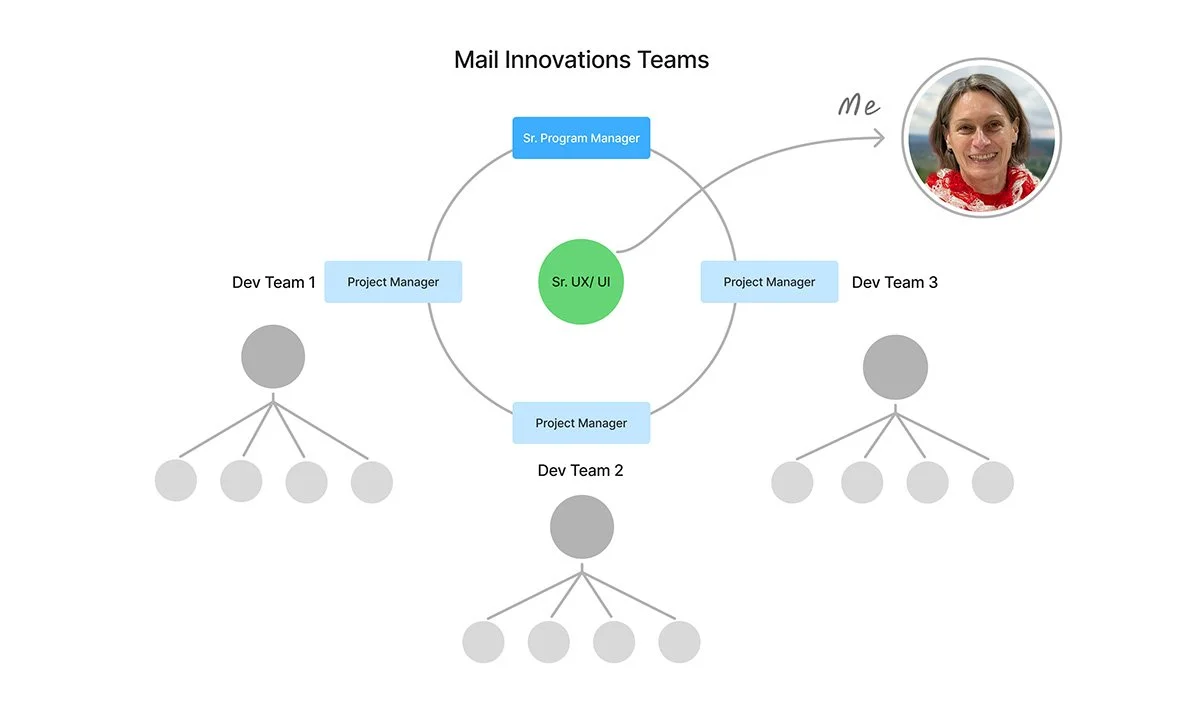
Over the course of 3 years I collaborated closely with a Sr. Program Manager, responsible for the modernization initiative, and 3 development teams each comprised of a Project Manager, Scrum Master and onsite or off-shore developers.
I changed a top-down piecemeal requirements gathering process to collaborative discovery and problem-solving. I led regular weekly research and synthesis workshops between me, the Sr. Program Manager and a Project Manager.
I socialized research and synthesis, and ensured teams understood the context and reasoning behind design decisions.
I created prototypes that were continuously reviewed and validated with stakeholders and developers.
Because of my knowledge of the uses and business processes, I collaborated with the Scrum Masters on feature and story writing and prioritization.
Defining Complex Business Processes and Goals
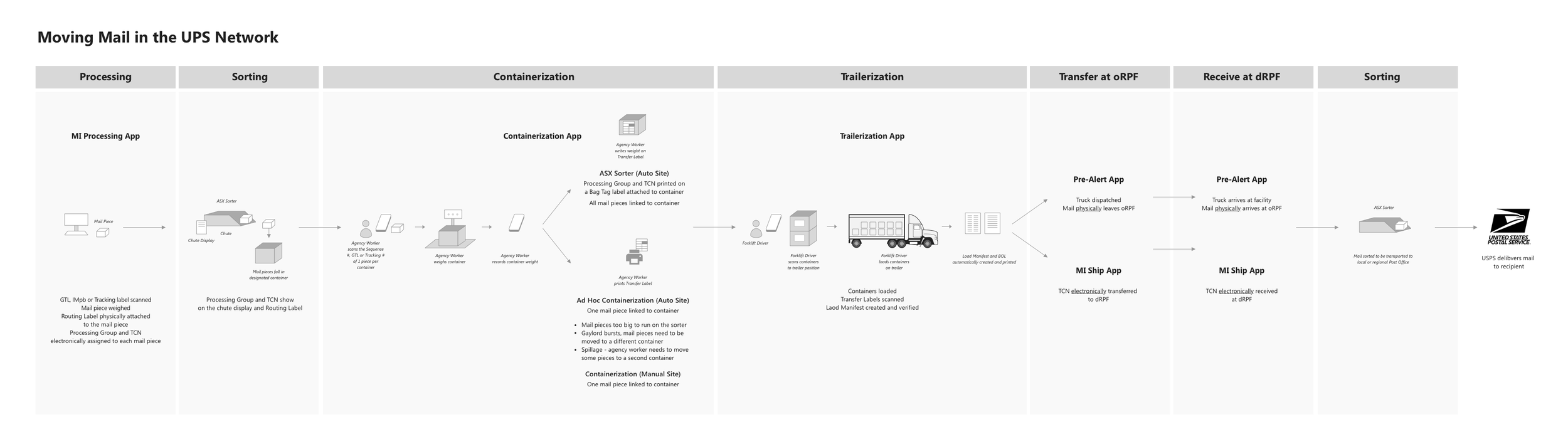
As soon as I finished documenting the legacy system and processes, I started working on a high level visual of the envisioned, new end-to-end business process. It provided context about the role of each application we were working on.
Summary of the cross-system user jobs and how they connected to the business goals
Creating Solutions that Connect Users’ Jobs and Business Goals
I directed the platform architecture to support the business goals and user needs for visibility and connectivity of information
I led system-wide research to identify cross-system problems and opportunities, and ensure strategic and holistic problem-solving.
Work on the first two applications (MI Processing and MI Trailerization) was self contained - there was no cross over in terms of users or operational processes. After the prototype of the second application, I realized there was a lot more to understand and document:
Data moving between various applications.
The role of each application in the system.
End-to-end operational processes supported by multiple applications and users.
User needs and goals spanning multiple applications.
Parallel to my research for each specific application, I had regular weekly meetings with the Sr. Program Manager and a Project Manager to discuss and align on the cross-system processes and use cases. We invited to the conversation other stakeholders and users - the Sr. Vice President of MI, Operations Supervisors, Transportation Managers, National Transportation Managers. We had:
Interviews and discussions
We looked at pictures, floor plans to understand key processes and workflows.
I started by documenting the legacy movement of mail pieces through the UPS pipeline. The research helped me understand the role of the legacy applications, key process steps and terminology. I worked with the Sr. Program Manager to define the high-level business pain points and envisioned opportunities for improvement.
Lifecycle of a mail piece - legacy processes is a visual documenting the movement of mail in the UPS network, the legacy applications and mail related data used, legacy pain points and opportunities for improvement.
FUTURE END-TO-END PROCESS
High-level steps
Applications and relationships
LEGACY SYSTEM & END-TO-END PROCESSES
Main steps
Legacy applications
Pain points
Opportunities

Moving mail in the UPS network - modernized processes and applications - a visual documenting the high-level modernized MI operations - processing, sorting, labeling and grouping mail in containers, loading onto trailers, creating accompanying electronic documentation, transferring mail from an outbound facility to an inbound facility.
LINKING HIGH-LEVEL PROCESS CHANGES TO BUSINESS GOALS
LINKING APP SPECIFIC PROCESS CHANGES TO BUSINESS OUTCOMES
Applications
High-level changes
App-specific outcomes
Overall business outcomes
Connecting process changes to business goals
In the past the development teams received piecemeal requirements from senior management and their work was focused on how to build things. Because of the complexity of the business processes any attempts to understand the why’s behind most business requirements felt overwhelming. This led to fragmented work, limited context and short term decision making.
To put things in a logical order and give our teams context and a North Star, I used the findings from the research on the legacy and new processes (see above) and linked the existing pain points to the proposed process changes and desired business outcomes.
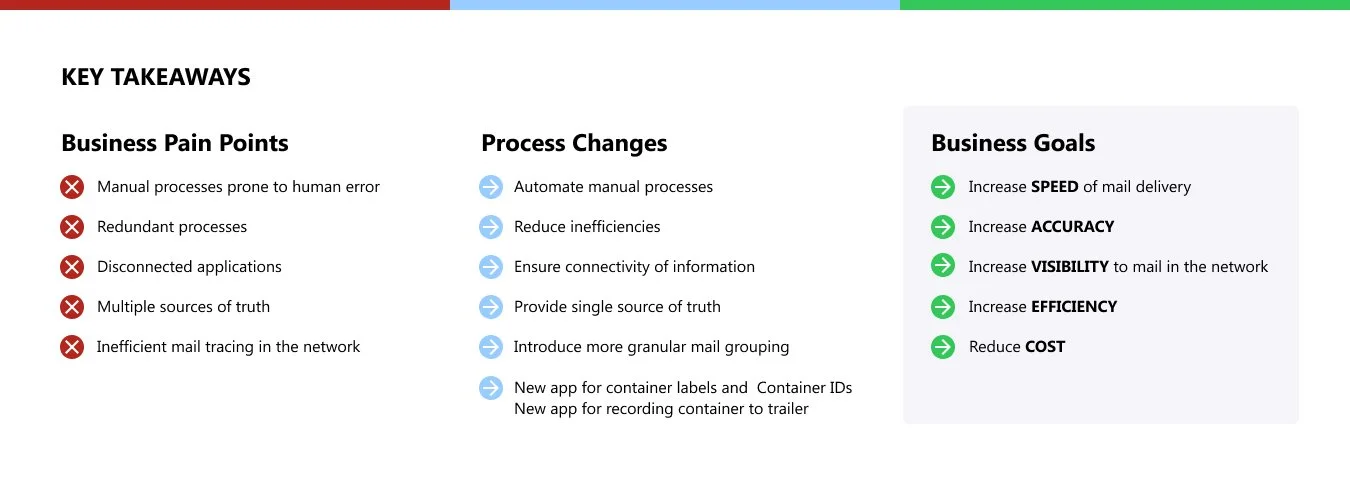
To deepen our understanding of how application-specific process changes contributed to the larger organizational goals, I created the following visual. The visual was validated with the Sr. Program Manager and a Project Manager, and reviewed with the 3 development teams.

Defining Cross-System User Types and Jobs
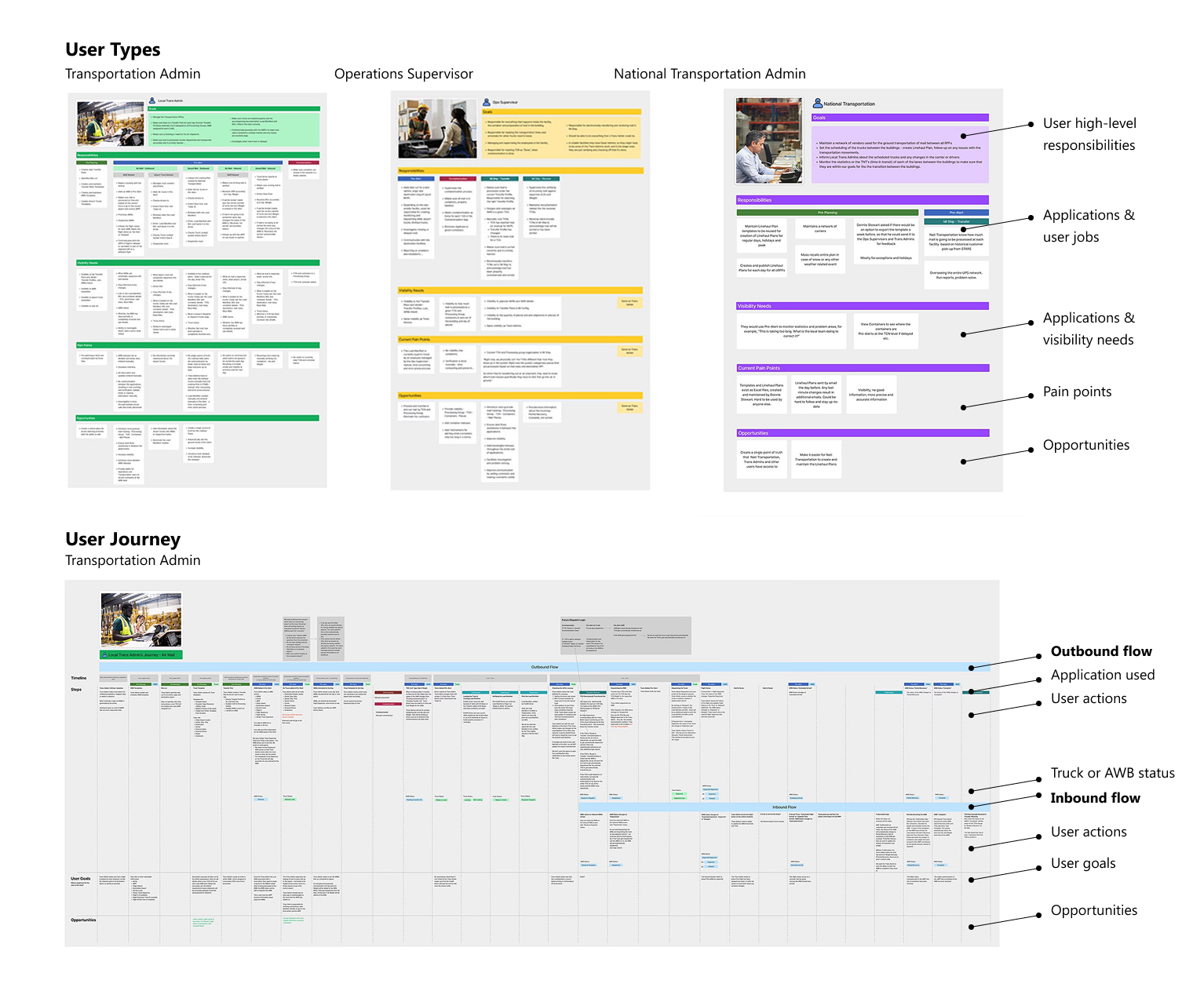
I documented cross-system user needs, user types and journeys to ensure our teams had a user-centered approach to problem-solving and design
Three user types used multiple applications in the system to plan and facilitate the movement of mail in the network. I worked with the Sr. Program Manager, a Project Managers and a National Transportation Admin as primary subject matter experts, but I also talked to Operations Managers and Supervisors to understand:
what were their daily responsibilities
how they used the apps
what was important for them to see and do
what was currently missing
My goal was to define the user jobs that contributed to the business goals and ensure our solutions were designed to help users perform their jobs successfully.
Ensuring connectivity of information was essential for automating the business processes and increasing the users’ visibility to mail in the system, which directly contributed to the accuracy and efficiency of moving mail in the UPS network.
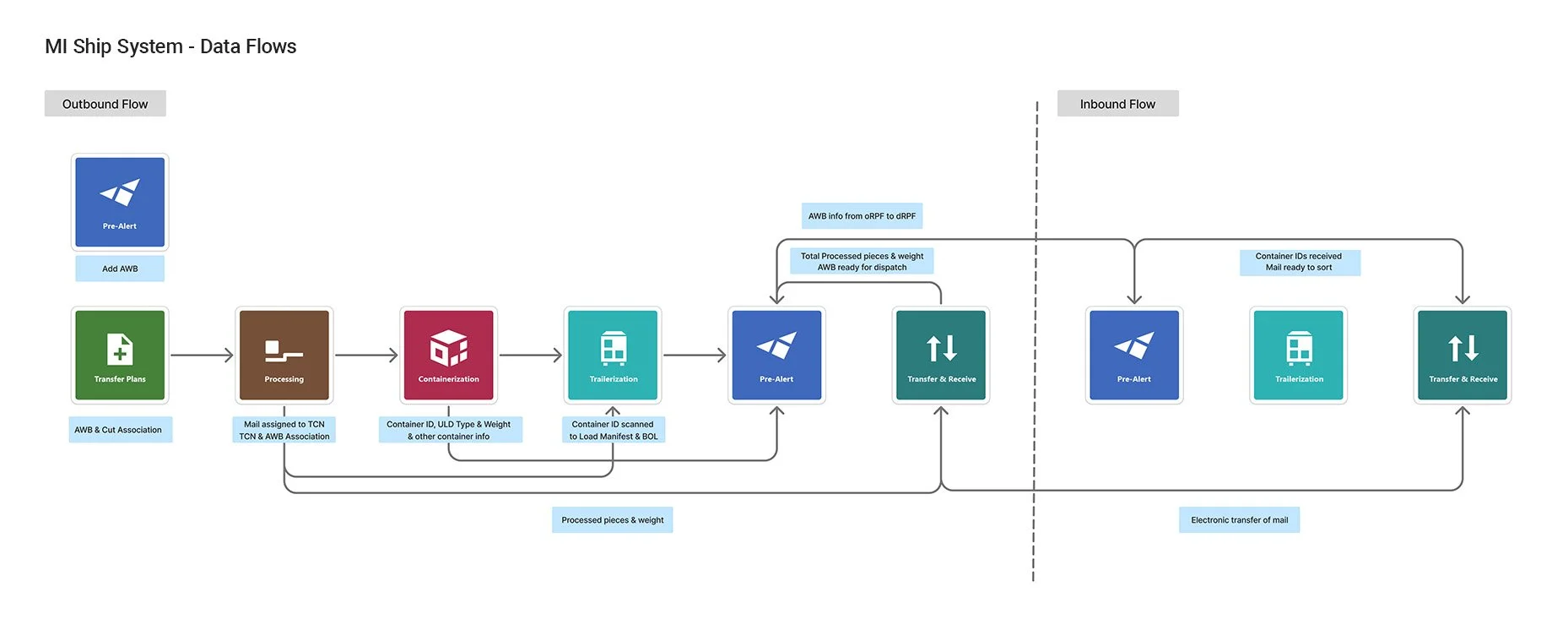
I helped the product triad shift from thinking piecemeal, one application at a time to considering the entire system.
I worked with the Sr. Program Manager on unified data flows for ground and air mail in the system and created visualizations.
The data flows laid the groundwork for creating solutions that addressed the users’ need for visibility and connectivity of information.
The data flows served as a solid ground for further decision-making, team alignment and planning.
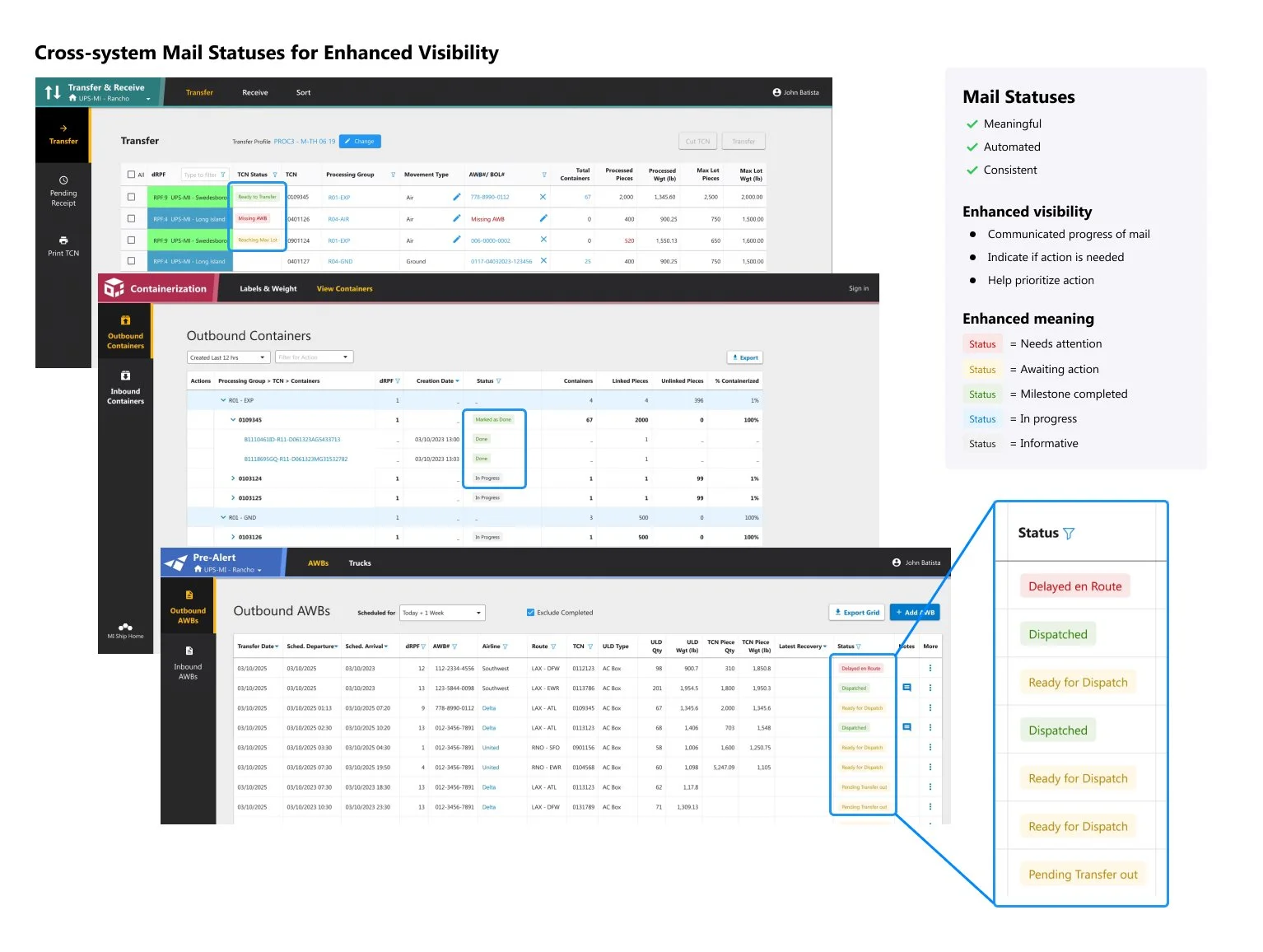
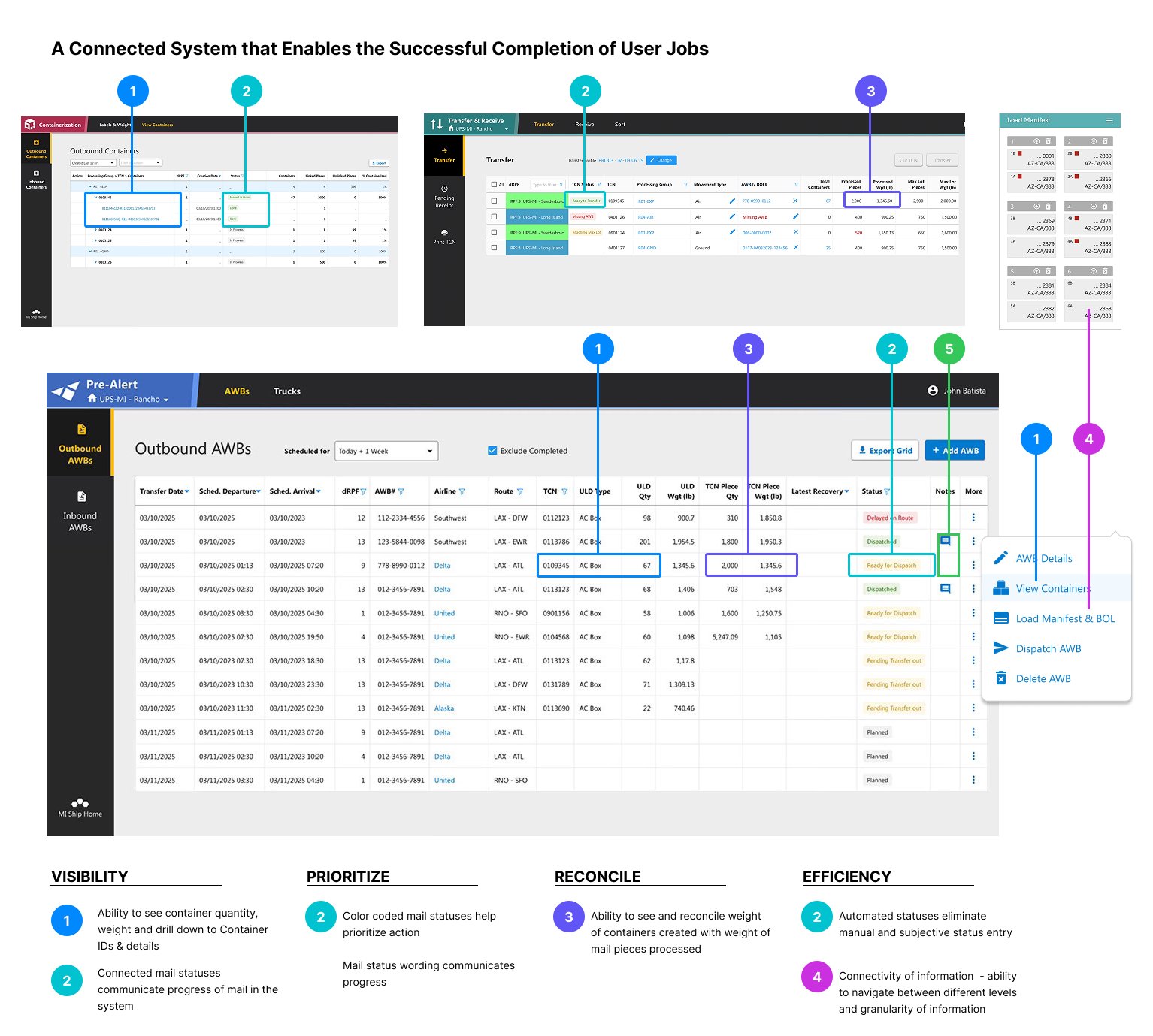
I led the creation of automated mail statuses across the system to support users’ need for visibility to mail in the system
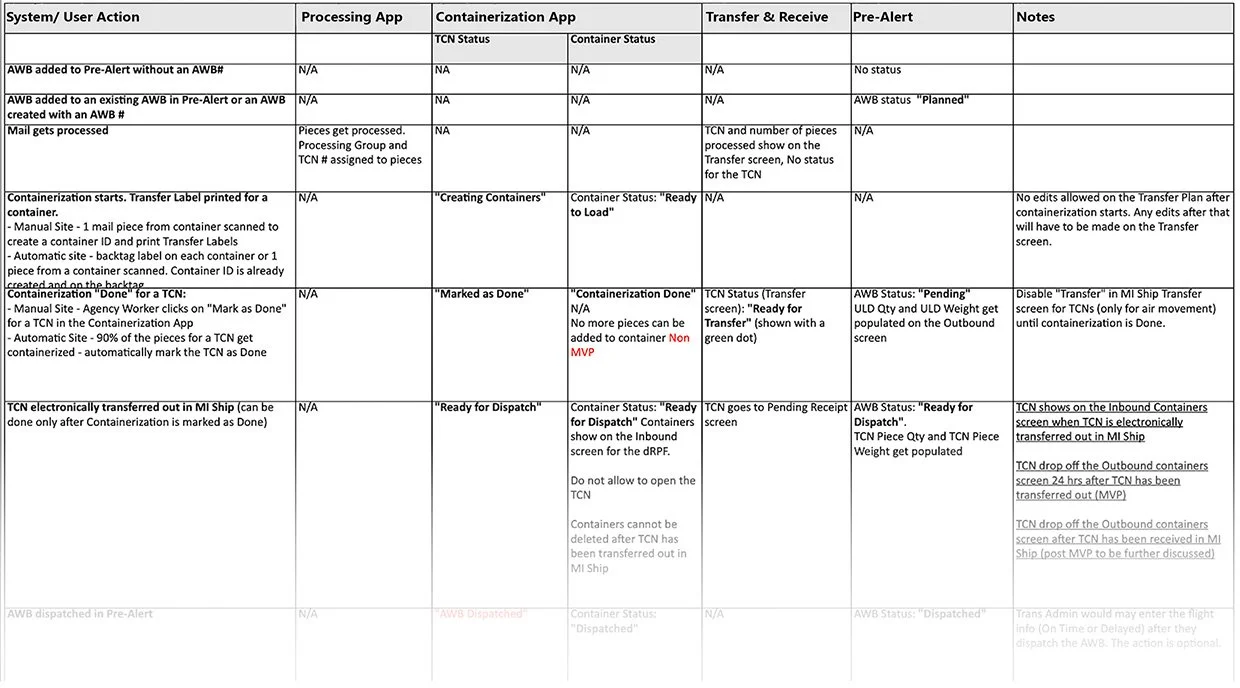
I initiated a conversation about adding meaningful, automated and consistent mail statuses across the Mail Innovations applications and worked closely with the Sr. Program Manager to define the dependencies, triggers and relationships between the applications. In the past mail statuses were used in only one application and were added manually. However, the primary job of Operations Managers and Transportation Admins was to monitor, facilitate and trouble-shoot the movement of mail in the system, a job they could not do effectively because the applications were disconnected and Operations Managers relied on observation and checking several applications multiple times.
Automating and connecting mail statuses across the system:
I initiated the creation of a document that captured the relationship between system and user actions and the respective changes across the system.
I documented and validated triggers, dependencies and app-specific status changes.
Below is an Applications and Mail Statuses Excel file that I created, discussed and validated to ensure we had a solid vision and teams worked with understanding and alignment.
Enhancing mail status meaning
In addition to creating the framework, I proposed meaningful status naming and color coding conventions to facilitate decision making and prioritization.
The visual below shows how mail statuses were used in 3 of the applications and how color was used to enhance meaning.
Creating a connected system of applications that supported users’ jobs
The decisions that we made as I worked on prototypes and validated them with the various stakeholders and development teams were all based on a solid understanding of the users’ jobs in support of the business objective of moving mail in the system quickly and accurately.
The Impact
I was able to make senior management and product teams zoom out and develop a system-wide clarity and vision for the future. This led to a system-wide product roadmap and an MVP plan for two separate mail transportation modes - air and ground.
The research I did and the visuals I created put concrete ideas at the table and enabled conversations that until then were impossible to have.
As a result, teams were able to align and prioritize problems and work on solutions that addressed concrete user needs and provided clear business outcomes.
Because we had 3 separate development teams working concurrently, having a roadmap and criteria to prioritize work was really helpful in streamlining everyone’s efforts and cutting out time and effort spent on disparate or unnecessary work.
In addition to designing for application-specific user needs, I helped the teams address cross-system user needs. As my research showed, user needs like visibility and speed could only be accomplished by making sure the applications in the system communicated the right data and allowed users to access the data they needed easily.
I joined the MI team through Cognizant and unfortunately was pulled out of the project before I could see the MVP air flow completed. Before leaving the project, the MI teams were still working on and testing parts of the MVP air roadmap. Because of the complexity and scope of the workflows, development work had to be done in stages. Having a roadmap ensured that even though we developed and tested work in stages, we were heading in an approved and clear direction.
Having a clear vision and understanding about how everything connected ensured that we moved in the right direction and allowed us to pivot or course correct faster, more effectively and less expensively.